 Tonic
Tuner · Metronome · Lessons · Backing Band
Tune.
Practice.
Play along.
Tonic is a tuner, metronome and practice app for iPhone and iPad. It's a precise tuner for every instrument, with guided lessons, a metronome and a band that follows your chords. One purchase, everything included: no subscription, no ads, and nothing leaves your phone.
$4.99 once · iPhone and iPad · iOS 17 or later · Works offline · English and Spanish
- Guitar
- Bass
- Ukulele
- Mandolin
- Banjo
- Violin
- Viola
- Cello
- Double Bass
- Brass
- Woodwinds
- Vocals
What you get
- One purchase, everything included
- No subscription
- No ads
- No account
- Nothing leaves your phone
- Works offline
- Works with VoiceOver
Tuner
Every instrument. Every tuning. Unlocked.
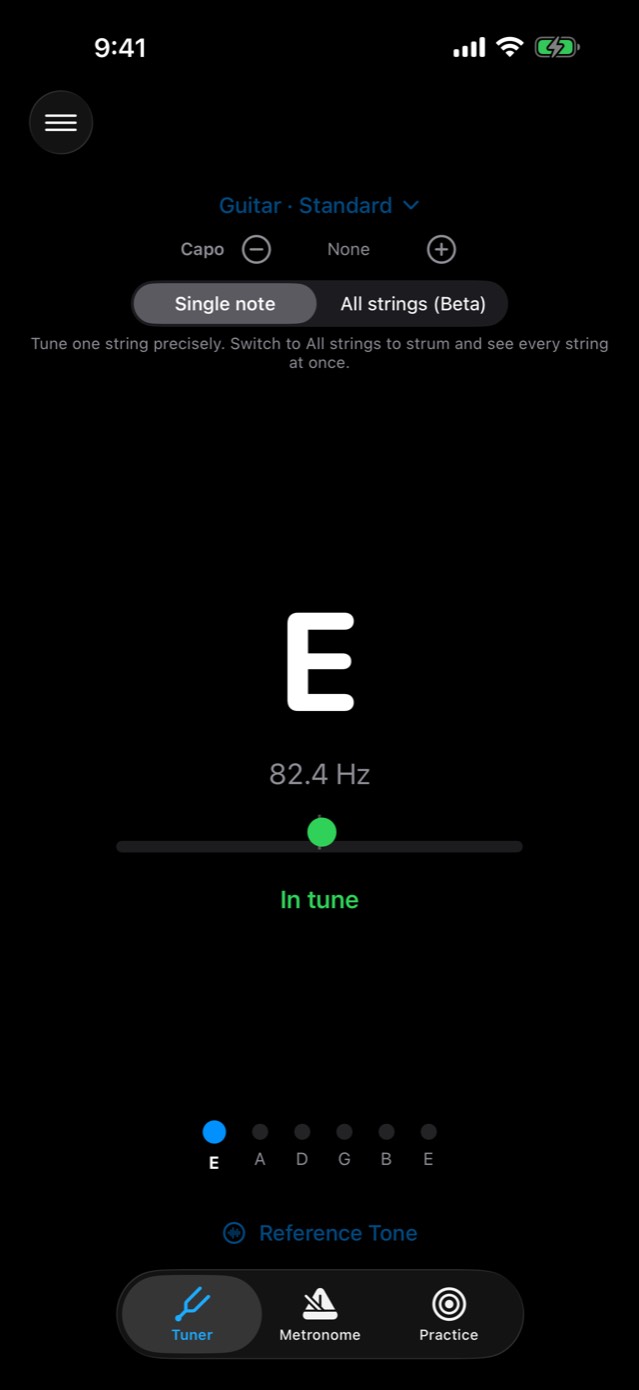
A cents meter that glides to the note and settles there, or a strobe for the last cent or two. Tune a guitar in standard, drop D, DADGAD, open G or any of 19 tunings, including 7-, 8- and 12-string and baritone. Tune a bass with four, five or six strings, a ukulele with high or low G, a mandolin, or a banjo in open G, Double C or Sawmill. Bowed strings are covered too: a violin in standard or cross tuning, a viola, a cello, or a double bass in orchestral, solo or fifths tuning. There are 13 brass and woodwinds, and a mode for your voice. Nothing is locked.
- Steady
- The needle glides between readings and holds on the note, so a ringing string doesn't make it twitch. "In tune" holds steady at the edge instead of flickering.
- Strobe
- The stripes drift when you're sharp or flat and stand still when you're there.
- Capo
- Tune with the capo on, and each string shows the note it really sounds.
- Winds
- Trumpet, clarinet, horn and the saxophones show the note you read, not concert pitch.
- A4
- Set it anywhere from 430 to 450 Hz, or show cents instead of Hz for setting intonation.
- Your own
- Save a custom guitar tuning, or tune by ear against a reference tone.
Which instruments and tunings are includedThe full tuning list
Practice lessons and drills
Lessons that open the right drill.
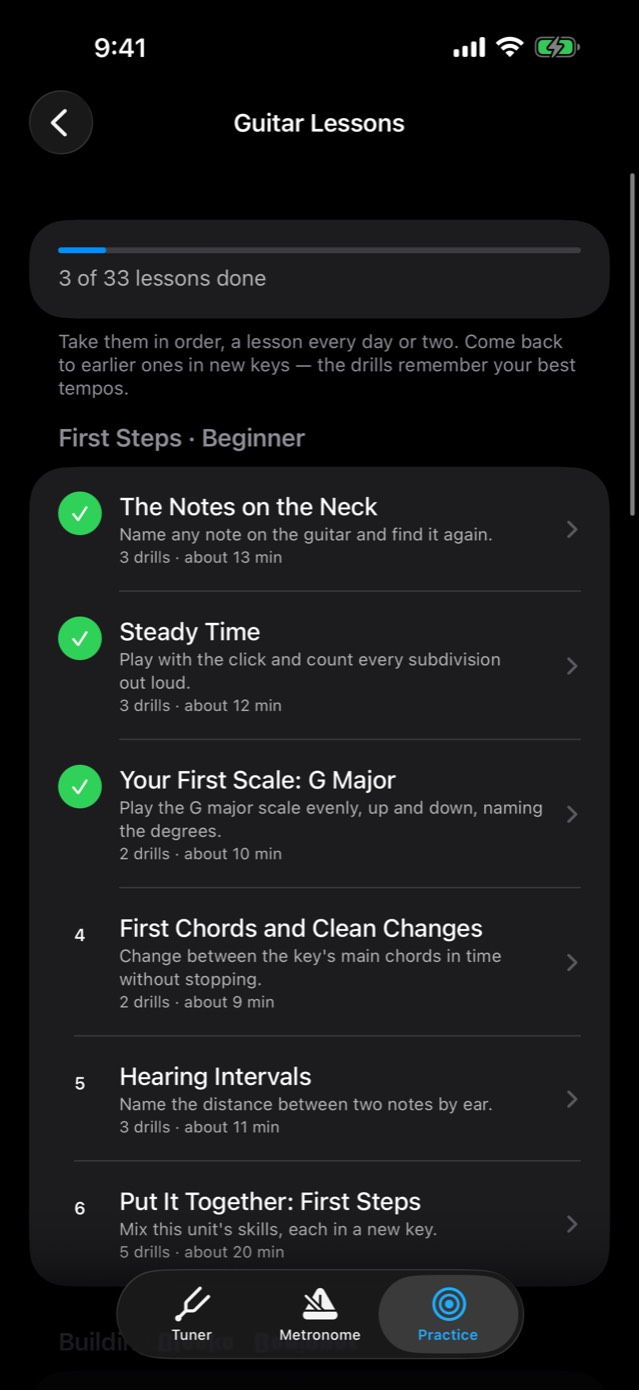
There's a guided course for guitar, piano, bass, mandolin, banjo, violin, viola, cello and ukulele. Each one runs from the notes on your instrument to improvising in every key. A lesson is a short read, then drills already set to the right key, scale and tempo. Mark it done and the next one is waiting.
- 48 drills
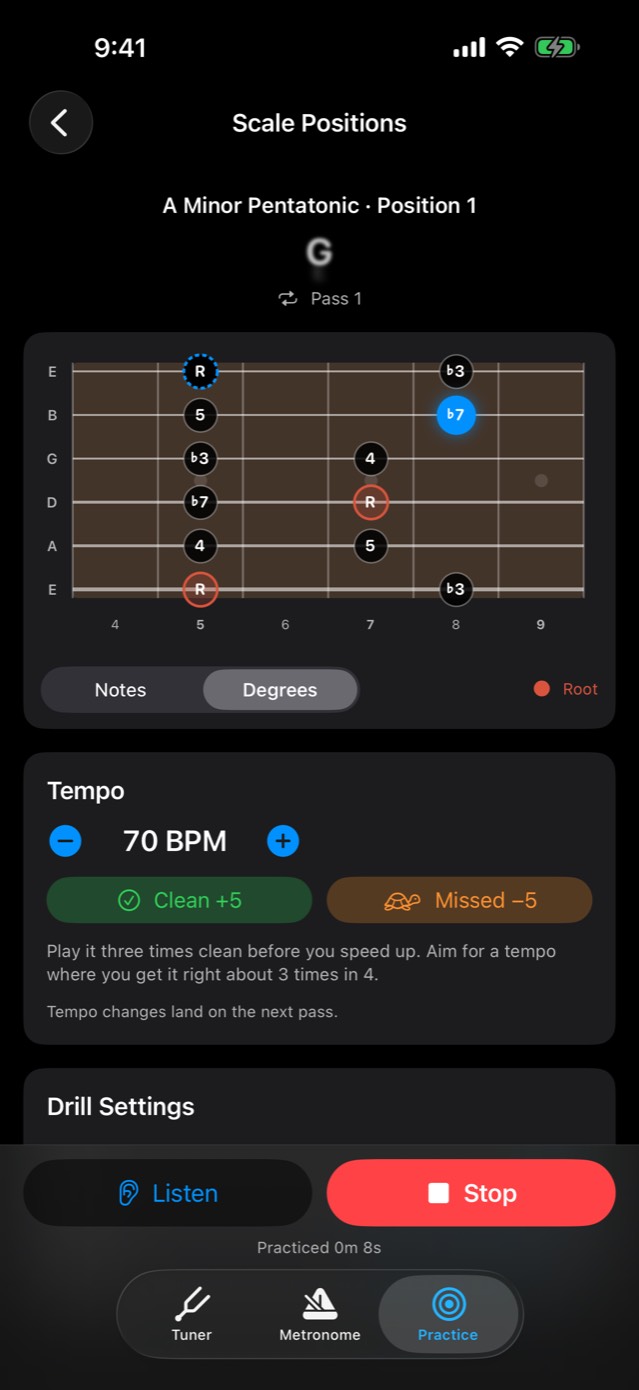
- Scales, arpeggios and triads, chord changes, licks, technique, rhythm and time, ear training, and knowing your neck. Each drill plays and shows on your neck or keyboard as it goes, in whatever tuning you use.
- Clean +5
- Play it clean and the tempo steps up 5 BPM. Missed it? It steps back 5. Your best clean tempo is saved.
- Every key
- Drills travel around the circle of fifths, so the scale you know in G turns up in D♭.
- Today's Routine
- One drill from each area, the one you've left longest first, each in a new key.
- Listen
- Play the drill yourself. Tonic follows you note by note through the mic and waits for each one.
- Banjo
- Every note is marked with its picking finger (T, I or M), the way banjo tab is written. There are three-finger rolls, and a Clawhammer & Old-Time unit with the bum-ditty, drop thumb, Double C and Sawmill.
Backing Band Beta
A band that follows your chords.
Drums, bass, keys and rhythm guitar, plus a pad, pedal steel or horn section. It plays 20 genres and 85 feels: Chicago and Texas shuffles, Detroit soul, funk, bossa nova, two-step country, '80s synth pop, spaghetti western and more. Give it a progression, or just start playing.
Follow Me
Start playing. Strum a few steady beats and a chord, and the band comes in on your next beat, at your tempo. Change chords and it changes with you, on the next beat. It keeps going until you stop it. Headphones help the mic hear you over the band.
- 12-bar
- Pick a blues feel and it loads the 12-bar form in your key.
- I–V–vi–IV
- Start from 20 named progressions, or build your own. Make any chord a 7th or sus, switch it between major and minor, then save it.
- Sections
- Give the chorus its own chords, and move through the song by bar count or on a tap.
- While it plays
- Change the tempo, the groove, any sound, the swing or the energy without stopping. Each change lands at the next bar.
- Your mix
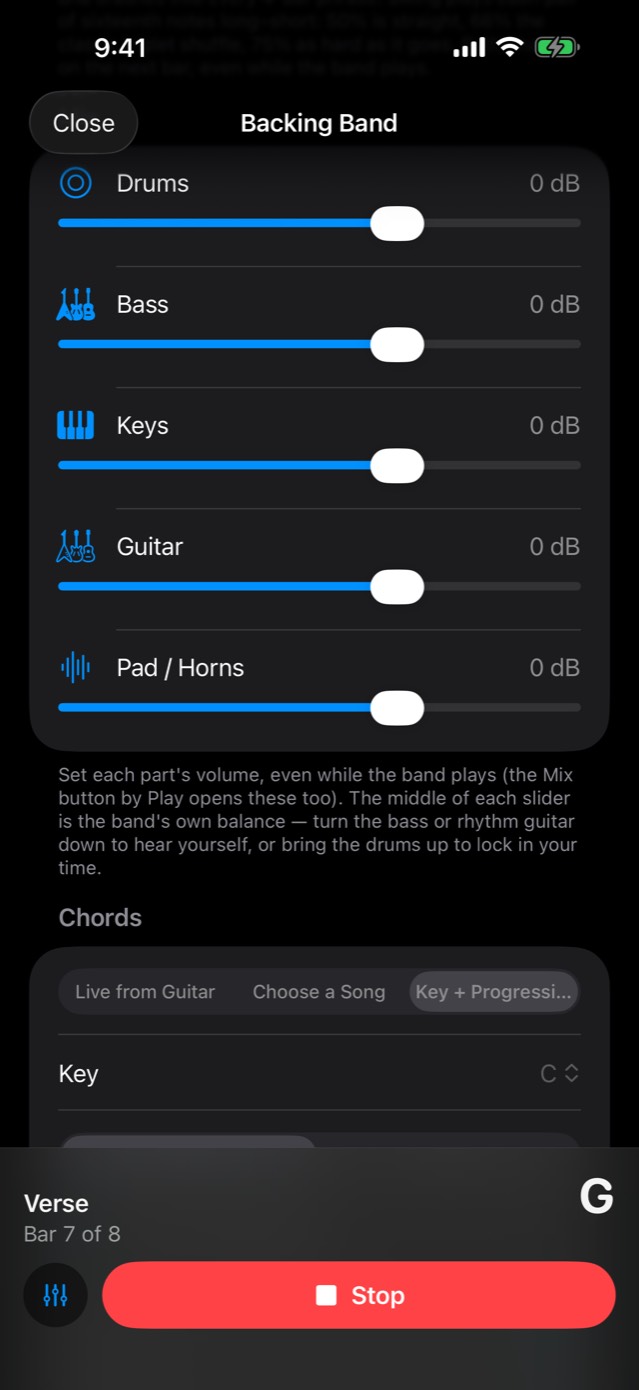
- Every part has its own fader. Turn the guitar down to make room for yours, then save the band by name.
Theory and instruments
Know what every chord is doing.
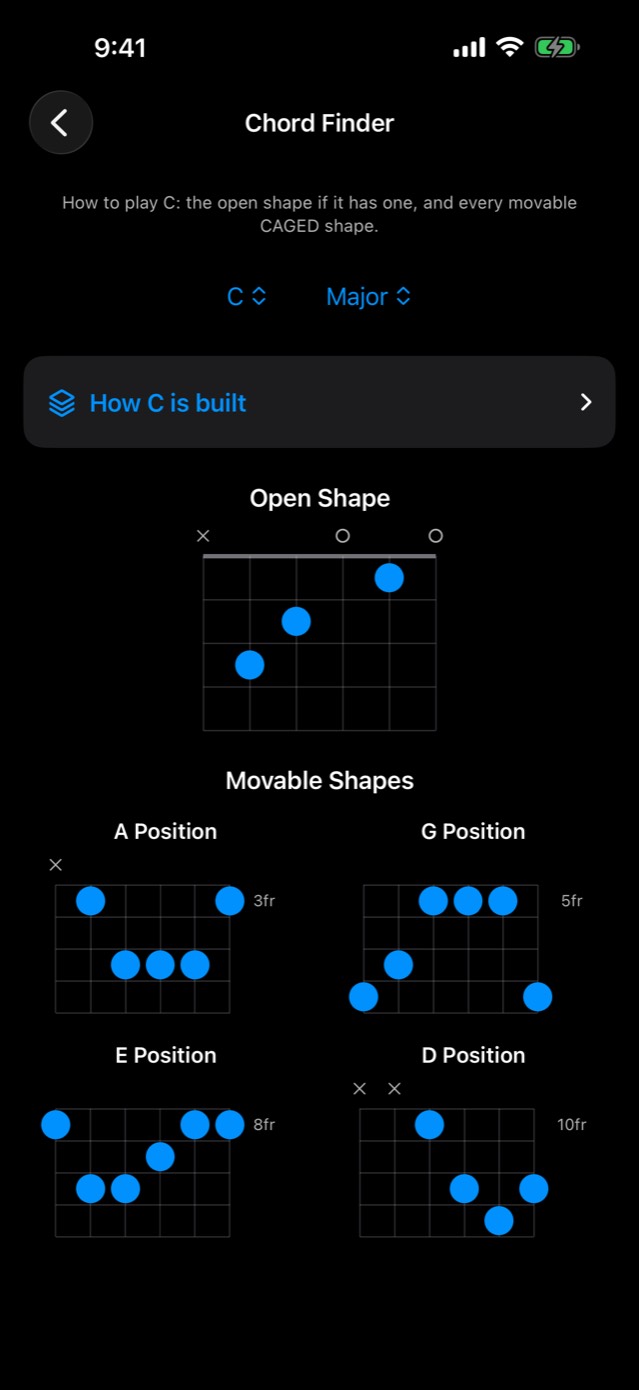
Why the V pulls you home and the IV feels like a lift. How a diminished chord is built: lower the 3rd and the 5th, C – E♭ – G♭. How to harmonize a melody in 3rds and 6ths, move through a progression with triads, and what to aim for when you jam. Then see it all on your own instrument.
- 1–7
- Every chord in a key, with its job, its notes and where it wants to go.
- 60+ progressions
- In any key, with every mode heard as the progression that makes it sound like itself.
- Triads
- Any progression as smooth triads on any three strings of a guitar, mandolin, ukulele or banjo.
- Reading
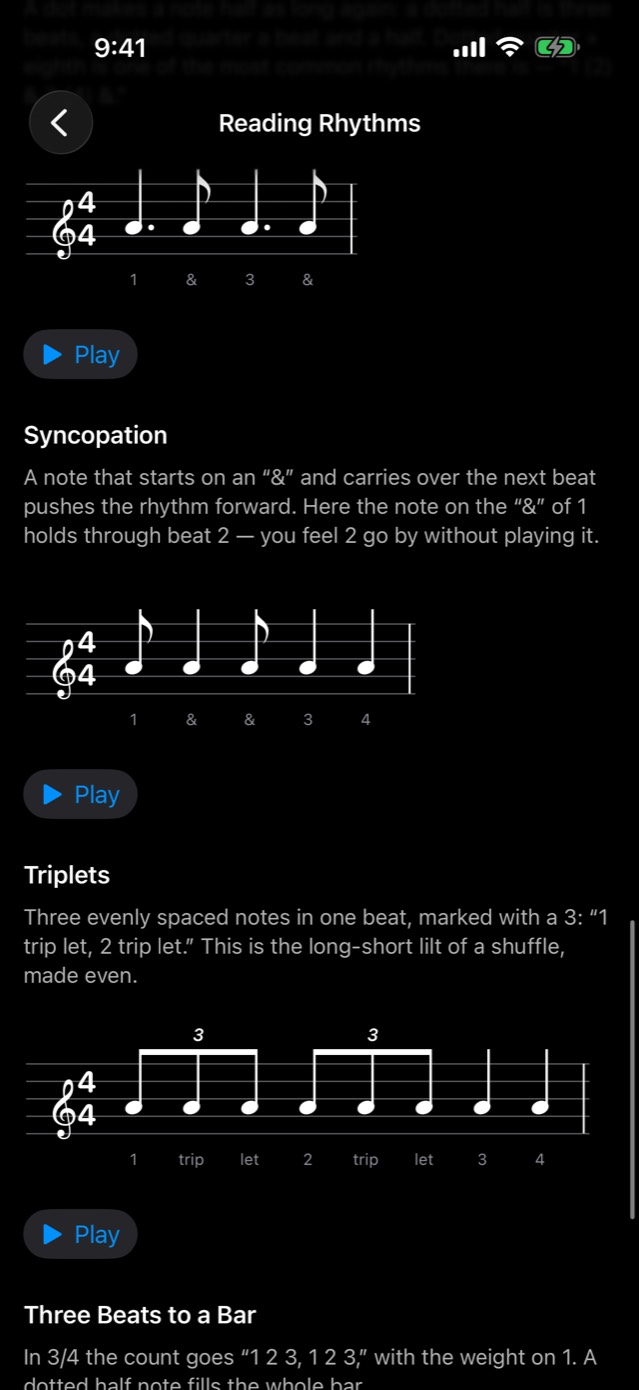
- Reading rhythms (counted and played), tab, chord charts, song form and Nashville numbers.
- Brass and woodwinds
- Fingering charts from trumpet to bassoon. Tap any note to hear it.
Also included
All of it is in the same purchase.
-
Metronome
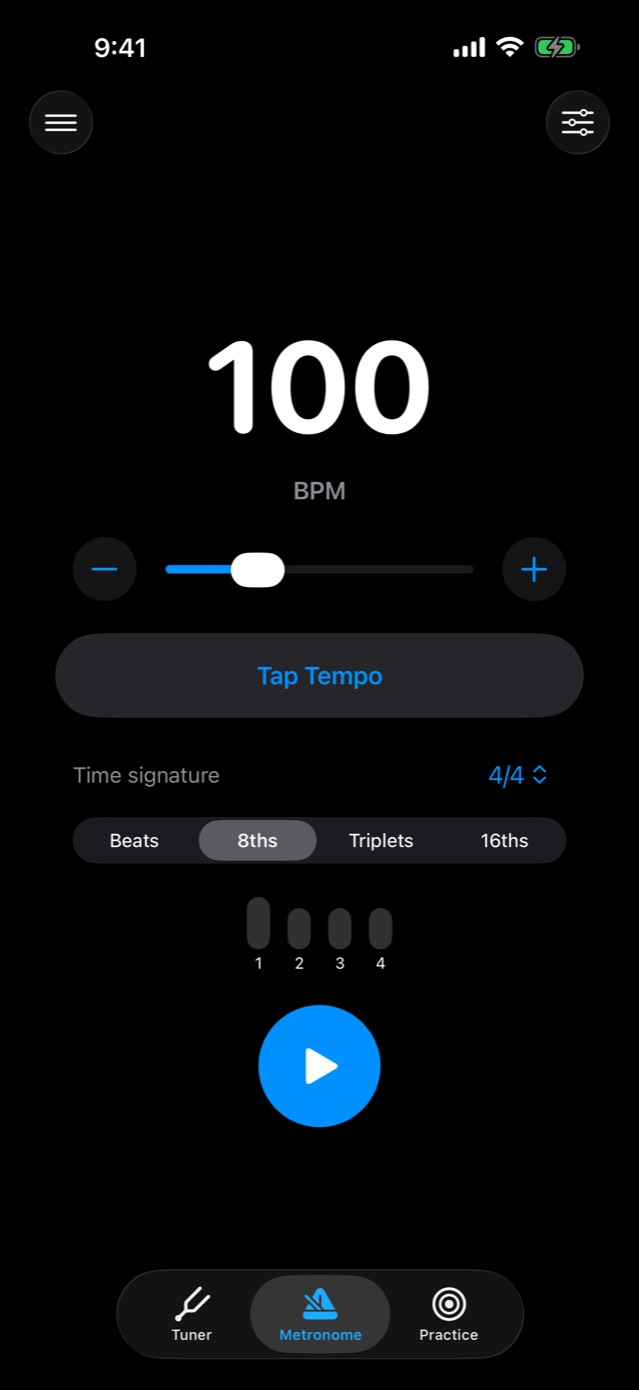
Subdivisions, an accent on any beat, and odd meters grouped the way they're felt, like 7/8 as 2+2+3. There's a speed trainer and a gap click, and it keeps time with the screen locked.
-
Key/Chord Finder Beta
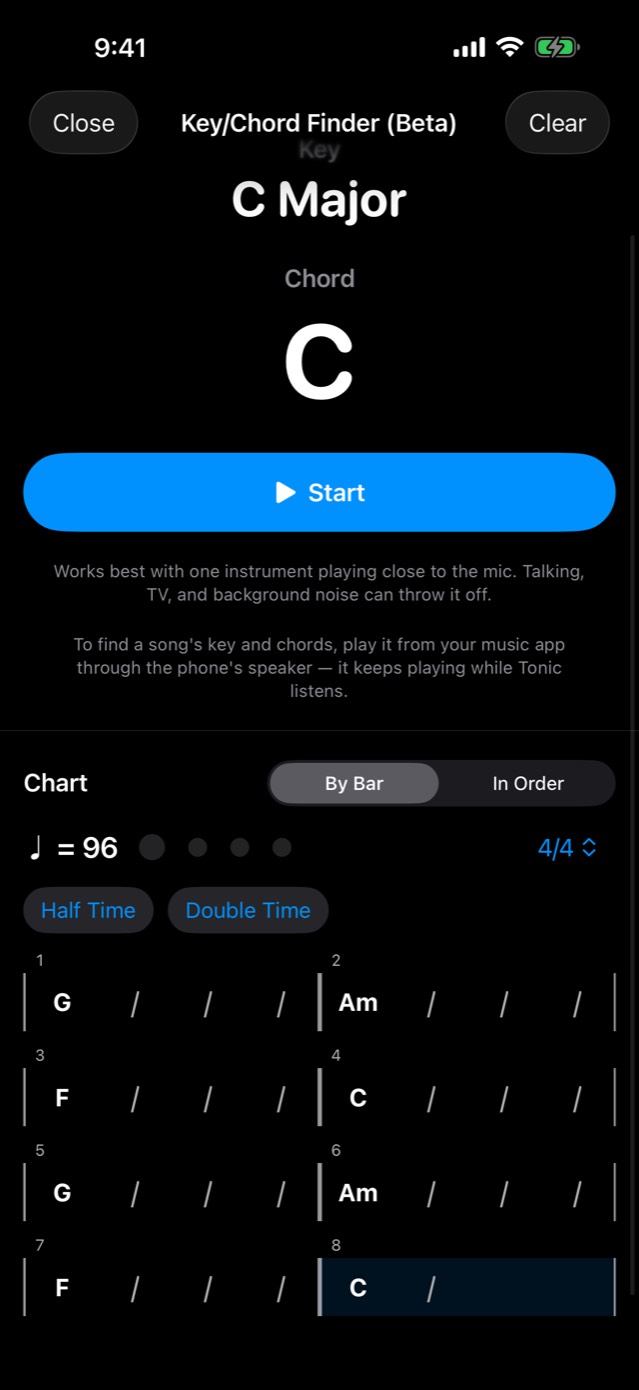
Play, or play a song through your phone's speaker. It names the key and chord and charts them bar by bar.
-
Recorder & Looper
Record with a count-in, then layer loops, undo or mute a layer, and save the mix.
-
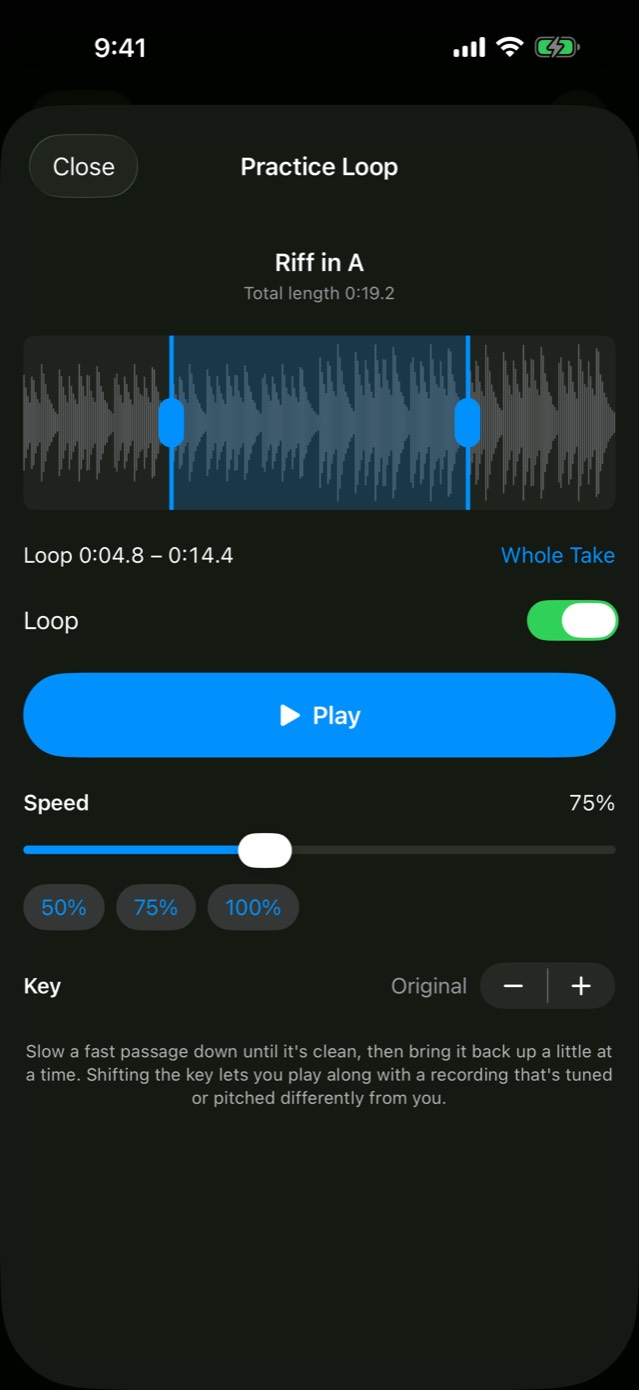
Practice Loop
Import a song from Files, loop the hard part, and slow it down to as little as 25% without changing its pitch.
-
Ear Training
Intervals, chord qualities and the chords of a key, by ear.
-
Songs
Sketch a song as a progression with a key, tempo, lyrics and notes, then hand it to the band.
Who it's for
Working guitarists
Every tuning you play in, drop D to DADGAD to 7-string, with capo mode and a strobe. It's steady in a loud room and needs no signal.
Beginners and players coming back
Open the Practice tab and start Lesson 1. Each day there's something to play next, and a tempo that grows with you.
Folk and old-time players
Guitar, mandolin, banjo, fiddle and uke in one app, in open G, Double C, Sawmill and cross tunings, with a Clawhammer & Old-Time unit.
Band and orchestra students
Viola, cello, double bass, and wind presets that show your written note. There are fingering charts, a metronome that counts 7/8, and rhythms you can hear.
Teachers
One app to recommend to every student, whatever they play. It has no account, no ads and nothing for a parent to approve, and courses for nine instruments give practice a shape.
Paid once. Yours for good.
Tonic costs $4.99, once. Every instrument, tuning, lesson, drill and band feel is in that one purchase, on iPhone and iPad, in English and Spanish. It works offline. Your music keeps playing when you open it, and the screen stays awake while you tune or practice.
What you won't find
- A subscription
- In-app purchases
- Ads
- An account or login
- Tracking or analytics
- Upgrade screens or nagging
Questions before you buy
$4.99 for a tuner?
It's a tuner, a metronome, lessons for nine instruments, a backing band and a theory reference. You pay $4.99 once, there's nothing left to unlock, and updates come through the App Store at no charge.
Is the tuner accurate?
It reads in cents, steadies the needle between readings, and has a strobe for the finest tuning. Raise the mic sensitivity for quiet instruments, and set A4 anywhere from 430 to 450 Hz.
Is it too much for one app?
Open it and it's a tuner. Tuner, Metronome and Practice are the three tabs you use every day. Everything else waits in the menu, and nothing pops up.
Does it need the internet, or my data?
No. Tonic never connects to the internet, has no account and collects nothing.
The Backing Band says Beta. Is it finished?
The feels, the mix, your progressions and saved bands are all complete. It's labeled beta because following live playing through a phone mic depends on the room and the instrument. It's included in the price, and headphones help.